

Golf Gloves: A 2026 Guide to Fit, Materials, and Performance
Table of Contents
- Why Golf Gloves Matter for Your Game
- Leather vs. Synthetic Golf Gloves: Which Material Wins
- How to Measure Golf Glove Size for a Perfect Fit
- Golf Glove Features That Improve Your Grip and Control
- When to Replace Your Golf Glove
- Care and Maintenance to Extend Glove Life
- Premium Golf Gloves Worth the Investment
- Frequently Asked Questions
Last Updated: September 23, 2026
Why Golf Gloves Matter for Your Game
A quality golf glove transforms how you connect with the club by improving consistency, reducing hand fatigue over 18 holes, and preventing slipping in humid conditions or when your palms sweat.

A worn glove forces you to increase grip pressure to compensate, which creates tension that disrupts your swing sequence and forces you to work harder for worse results.
The right golf glove maintains grip consistency regardless of weather, reduces hand fatigue across 18 holes, and provides tactile feedback about club position throughout your swing.
Leather vs. Synthetic Golf Gloves: Which Material Wins
The choice between leather and synthetic golf gloves affects grip consistency, durability, maintenance, and cost. Understanding these differences helps you match the material to your playing style and climate.
Cabretta leather: The premium standard
Cabretta leather dominates professional golf because it delivers superior grip consistency and tactile feedback. This soft, fine-grained sheep leather naturally conforms to your hand shape, creating a personalized fit over time.
Cabretta leather's natural tackiness creates friction without chemical coatings and lasts longer than synthetic alternatives. A quality cabretta leather glove maintains usable grip for 30-40 rounds before the palm becomes noticeably smooth.
Cabretta leather's porous material allows moisture to pass through rather than accumulate, keeping your hand cooler and reducing slipperiness from sweat. This makes leather preferable in warm conditions (70°F and above).
Leather provides superior tactile feedback that helps you sense club position and maintain consistent grip pressure. Tour professionals prefer leather for this real-time grip information that influences swing execution.
The trade-off is maintenance and cost. Cabretta leather requires care to avoid stiffening or losing shape, and costs 40-60% more than synthetic gloves upfront.
Synthetic materials: Durability and all-weather performance
Synthetic golf gloves use microfiber polyester blends with reinforced palm areas, excelling where leather falls short.
All-weather synthetic gloves maintain grip in rain because the material doesn't absorb water and the palm coating increases friction when wet, while leather becomes dangerously slippery.
Synthetic gloves resist abrasion better than leather, lasting 50-60 rounds before grip fades versus 30-40 for leather. This durability advantage matters for golfers playing 2+ rounds per week.
Synthetic gloves require virtually no maintenance, just rinse and air-dry. This appeals to casual golfers who play infrequently.
Synthetic gloves cost 30-50% less upfront, a meaningful advantage for developing golfers or those in consistently wet climates.
The trade-off is tactile feedback. Synthetic gloves feel less responsive because the grip texture is a surface coating that wears away noticeably. For golfers focused on swing precision, this feedback loss is a real disadvantage.
Hybrid and specialty materials
Hybrid gloves blend cabretta leather with synthetic reinforcements, offering leather's tactile feedback in the palm while gaining synthetic's durability and weather resistance on the back.
Specialty materials include cold-weather synthetics with thermal lining (below 50°F), rain-specific synthetics with enhanced grip coatings, and summer breathable synthetics with perforations for maximum airflow (80°F+).
Choosing based on your playing conditions and frequency
Choose cabretta leather for regular play (1+ round/week) in temperate conditions if you value swing consistency. Choose synthetic for wet climates, infrequent play, or cold conditions. For variable conditions, use leather in dry weather and keep a synthetic glove for rain.
How to Measure Golf Glove Size for a Perfect Fit
Golf glove sizing depends on one measurement: the distance across your palm from the base of your thumb to the base of your pinky finger. Most golfers measure incorrectly using full hand length, shoe size, or clothing sizes.
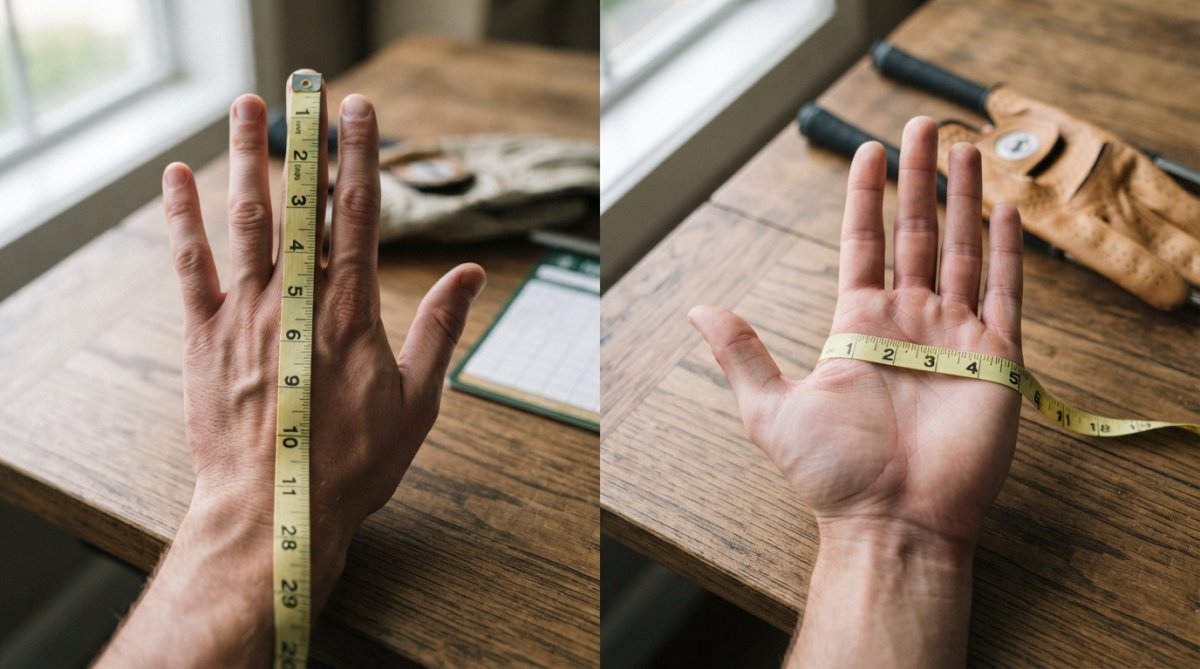
Step-by-step measurement process:
Between the Lines Golf Glove - Total →
- Use a soft measuring tape (not a rigid ruler). Rigid tools compress your palm and give inaccurate readings.
- Place your hand flat and relaxed on a table or counter. Your fingers should be slightly spread but not stretched, and your palm should be completely flat, no cupping or tension.
- Measure horizontally across the widest part of your palm, from the base of your thumb to the base of your pinky finger. This is the measurement that determines glove size.
- Record the measurement in inches to the nearest half-inch. Round down if you're between sizes (for example, 7.75 inches rounds to 7.5 inches).
Size chart reference:
- 6.5-7 inches = Small
- 7.5-8 inches = Medium
- 8.5-9 inches = Large
- 9.5-10 inches = Extra Large
- 10.5+ inches = XXL (specialty sizing)
Common sizing mistakes that lead to poor fit:
Common mistakes: measuring full hand length overstates size by one size; measuring while making a fist compresses your palm; assuming dominant hand size matches your glove-wearing hand. Always measure your actual glove-wearing hand in a relaxed state.
Testing fit after you receive your glove:
A properly fitted golf glove feels snug across the palm without restricting blood flow, allows a full fist without bunching, and has minimal excess material at fingertips (within one-eighth inch). The wrist closure should be snug enough to fit one finger underneath when fastened.
Hand orientation and which hand wears the glove:
Right-handed golfers wear the glove on their left hand. Left-handed golfers wear it on their right hand. This is the hand that experiences the most pressure and friction during the downswing and follow-through. The glove protects that hand from blisters, reduces fatigue, and provides the grip consistency your swing depends on. Wearing a glove on the wrong hand defeats its purpose and creates an awkward, unstable grip.
Sizing considerations for different hand shapes:
Prioritize palm fit over finger length. If your hands swell during play, measure after a round rather than in the morning for a more accurate fit.
Golf Glove Features That Improve Your Grip and Control
Grip consistency comes from three design elements working together: palm reinforcement, material choice, and texture. The palm reinforcement is the thickened area across the inside of your hand where pressure concentrates during your swing. A well-designed reinforcement distributes pressure evenly without creating dead spots where your grip weakens mid-swing.
Tacky texture matters more than most golfers acknowledge. The surface of a quality golf glove has a slightly sticky feel that increases friction between your skin and the leather or synthetic material. This friction is what prevents slipping. As you wear the glove, this texture gradually fades, which is why you eventually need to replace it. Maintaining a secure grip remains essential throughout your motion, much like selecting golf shirts that provide the necessary range of motion for an unrestricted swing.
Perforated knuckles and stretch panels serve different purposes. Perforations reduce moisture buildup in high-sweat areas, improving breathability and extending the glove's usable life. Stretch panels (usually on the back of the hand) allow natural hand movement without the glove restricting your fingers. A glove with both features adapts to your hand's actual movement patterns rather than forcing your hand into a predetermined shape.
The Between the Lines Golf Glove incorporates finger perforation for optimal breathability when you're making tough shots. The adjustable tab closure allows a customized fit that tightens or loosens depending on how your hand swells during play. This single feature prevents the common problem of a glove becoming loose and slipping as your hand warms up during the round.
When to Replace Your Golf Glove
A golf glove typically lasts 30-40 rounds of play before the grip deteriorates noticeably. This timeline assumes regular maintenance and storage. A glove that sits in a hot car or gets wet and dries improperly will fail much sooner. A glove stored in a cool, dry place can extend its life by 10-15 rounds.
The first sign of wear appears in the palm reinforcement. When that area becomes smooth and shiny instead of tacky, your grip consistency suffers immediately. You'll notice you need to increase grip pressure to keep the club from slipping. That's your signal to start looking for a replacement.
Secondary wear appears on the underside of your fingers and around the thumb. If you see cracks forming or the material thinning, the glove is near the end of its life. Some golfers continue using a worn glove in dry conditions when they wouldn't trust it in humid weather. That's a reasonable approach if you play in variable climates.
Moisture damage shortens glove life dramatically. A glove that gets soaked and dries in direct sun will lose its shape and grip properties.
Care and Maintenance to Extend Glove Life
Proper storage is the single most important factor in glove longevity. Store your glove flat or loosely rolled in a cool, dry place away from direct sunlight. Never store it in a plastic bag, which traps moisture. Never leave it in your golf bag between rounds, that's where most glove damage happens. The combination of moisture, heat, and compression breaks down the material and shapes.
Premium Golf Gloves Worth the Investment
Premium golf gloves deliver measurable improvements in grip consistency and durability that justify their higher cost. The difference isn't just materials, it's engineering. A premium glove has better palm reinforcement design, superior texture that lasts longer, and construction that maintains its shape through dozens of rounds.
Frequently Asked Questions
How often should you replace your golf glove?
Most golfers replace their golf gloves every 40 rounds or when grip deteriorates. Signs you need a replacement include worn palm areas, reduced tackiness, visible fraying at seams, or loss of flexibility. Frequent players may replace gloves every 2-3 months, while casual golfers might get 6+ months from a single pair. Proper care extends life significantly.
What's the difference between leather and synthetic golf gloves?
Cabretta leather offers superior tactile feel, better grip consistency, and natural breathability but requires more maintenance and costs more upfront. Synthetic materials provide all-weather performance, durability in wet conditions, and easier care at a lower price point. Leather excels in dry conditions and delivers tour-level performance; synthetics are ideal for variable weather and high-wear situations.
How do I measure my hand for the correct golf glove size?
Measure across your palm (excluding the thumb) from the base of your hand to your knuckles using a soft measuring tape. Your glove should fit snugly without bunching or excess material. When in doubt, order your exact measurement or slightly smaller for a secure fit.
Do golf gloves really make a difference in your game?
Yes. Golf gloves improve grip consistency, reduce hand fatigue during long rounds, and enhance club control through better tactile feedback. They prevent blisters and provide swing precision by maintaining contact with the club. The right glove reduces grip pressure needed, allowing smoother swings. Most golfers notice improved performance and comfort within their first few rounds using a properly fitted glove.