

How to Identify Authentic Handcrafted Art: Buyer's Guide
Table of Contents
- Why Authenticity Matters When Buying Handcrafted Art
- How to Tell If Art Is Handmade or Mass-Produced
- Hand-Painted Art vs Prints: Telling Them Apart
- Signatures, Marks, and the Artist's Body of Work
- Materials, Pigments, and Period Consistency
- Provenance and Ownership History: Tracing a Piece
- What a Certificate of Authenticity for Art Should Include
- Questions to Ask When Buying Art From a Seller
- A Practical Checklist for Handcrafted Art and Craft Objects
- Distinguishing Handmade, Hand-Finished, Limited-Edition, and Mass-Produced
- When Authenticity Is Uncertain: Your Options as a Buyer
- Frequently Asked Questions
Last Updated: October 19, 2026
Why Authenticity Matters When Buying Handcrafted Art
Authentic handcrafted art carries the marks of a human hand and a human decision.
Learning to identify authentic handcrafted art protects your money and rewards real makers. A mass-produced piece sold as handmade costs you twice: at checkout, and again when it fails to feel special.
This guide walks through the checks we would use ourselves: reading brushstrokes, spotting mold lines, comparing signatures, and asking sellers the right questions.
How to Tell If Art Is Handmade or Mass-Produced
Handmade pieces show small irregularities across the whole object; mass-produced pieces show perfect repetition and hidden shortcuts. Look for variation first, then for the machine marks uniformity leaves behind.
Start with a close look at the surface. Real handwork leaves evidence that is hard to fake at scale. Here is what separates the two:
- Slight variation between pieces. Two plates in a set should look like siblings, not clones.
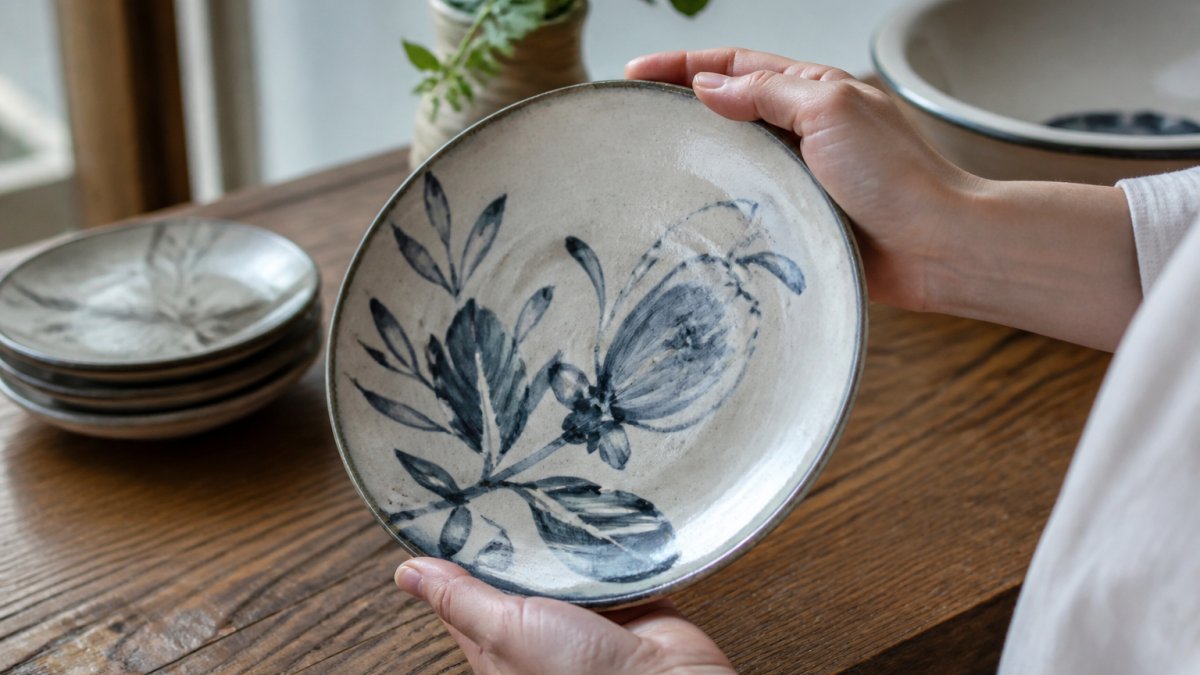
- Tool marks. Brush hairs, tiny ridges, or a potter's finger press show a person at work.
- Weight and balance. Hand-thrown ceramics often feel slightly uneven, which is normal.
Medium-Specific Checks: Ceramics, Textiles, Jewelry, Woodwork, and Metalwork
Most authentication advice online is written for paintings. Craft objects need their own checks.
Ceramics and pottery. Turn the piece over.
Jewelry. Hand-fabricated metalwork shows solder seams, file marks, and slight asymmetry in settings; cast jewelry often has a sprue mark or seam line.
Woodwork. Hand-cut joinery shows layout marks, slight gaps, and tool marks. Hand-cut dovetails vary in spacing and angle; machine-cut ones are identical.
Signs of Handwork: Brushstrokes, Texture, and Surface
Brushstrokes are the clearest signature of a human hand. Under raking light, hand-painted decoration shows raised edges where paint sits on the surface, and color shifts where the artist reloaded the brush.
Texture matters too. Hand-built ceramics show a subtle wobble in the rim; hand-woven textiles show small tension changes. If the surface feels perfectly flat and glassy everywhere, ask how it was made.
Signs of Mass Production: Uniformity and Molds
Uniformity is the giveaway. If every unit on the shelf is identical down to the millimeter, a mold or a printer made it. Look for seam lines, ejector pin marks, and printed patterns that wrap perfectly around curves.
Mass-produced items are not bad objects, they are just not handmade, and should not be priced as if they were. Compare two pieces of the same design side by side: if you cannot tell them apart at arm's length, a machine likely did the forming.
Hand-Painted Art vs Prints: Telling Them Apart
Hand-painted art has physical paint sitting on the surface; a print is ink or dye applied by machine and usually sits flatter. The difference shows up under a magnifier and angled light.
Try these checks:
- Look at an angle. Hand-painted areas catch light unevenly. Prints reflect uniformly.
- Use a magnifier. Prints show a dot pattern or a fine halftone screen. Hand-painted areas show continuous color.
- Touch the edge. Paint often has a slight ridge at the border of a design. Ink does not.
If a seller calls a piece "hand-painted" but the pattern repeats perfectly, ask for a photo at an angle. A real maker will send one without hesitation.
Signatures, Marks, and the Artist's Body of Work
A signature is only useful compared against a known body of work. One signature in isolation proves little; one that matches the artist's style, materials, and period proves a lot.
Ask the seller for the artist's name and where else their work appears. Then compare:
- Signature style. Does the lettering match other signed pieces by the same artist?
- Maker's marks. Potters often stamp a mark on the base. Compare the stamp shape and depth.
- Date conventions. Does the date format fit the artist's era and habits?
A mismatch between the signature and the artist's known work is a serious red flag. So is a signature that looks too clean, too centered, or painted on top of a finished surface.
Materials, Pigments, and Period Consistency
Materials tell time. Pigments, glazes, fibers, and canvas all have histories, and a piece should match the era it claims to come from.
Look for these clues:
- Wear patterns. Age shows up at edges, handles, and bases, not in the center of a flat surface.
- Fading. Natural dyes and older pigments fade unevenly. Modern dyes tend to hold color.
- Crazing. Fine cracks in old glaze are normal. Perfectly smooth glaze on a supposedly antique piece is suspicious.
Professional labs can run pigment analysis, X-ray, or carbon dating when the stakes are high, but those tests are costly and reserved for valuable pieces. For everyday purchases, careful visual inspection gets you most of the way there.
Provenance and Ownership History: Tracing a Piece
Provenance is the documented story of who owned a piece and when. A strong chain includes receipts, gallery records, exhibition lists, or family paperwork; a weak one is a verbal story with nothing behind it.
Ask for the chain in writing:
- Where was it bought, and when?
- Who owned it before the seller?
- Are there receipts, invoices, or gallery records?
Gaps are normal, especially for older pieces. What matters is whether the seller explains them honestly. A seller who fills every gap with a perfect story is often inventing one.
What a Certificate of Authenticity for Art Should Include
A certificate of authenticity for art is a signed document identifying the piece and its maker. It is only as good as the person or business behind it: a certificate from the maker or a reputable gallery carries weight, a generic printed card carries none.
A useful certificate includes:
- Artist or maker name
- Title and description of the piece
- Medium and materials
Keep the certificate with the piece. It helps at resale and if a question ever comes up.
Questions to Ask When Buying Art From a Seller
The right questions separate confident sellers from evasive ones. Ask plainly and listen to how the answers come back, a real maker will enjoy the conversation. When you cannot inspect a piece in person, the exchange itself becomes part of the authentication.
Here is our short list:
- Who made this, and where do they work?
- Can you show me photos of the process?
- Is this handmade, hand-finished, or mass-produced?
- What materials were used?
- Does it come with a certificate of authenticity?
- What is the return policy if the piece is not as described?
- Can I see a close-up photo at an angle?
If you are shopping online, ask for extra photos in natural light and about sizing and finish. A seller who answers quickly and specifically is usually worth trusting.
Verifying Handmade Claims in Online Listings
Online buying removes the sense of touch, so replace it with evidence. Work through the listing in this order.
Read the maker description closely. A specific description names the technique, materials, and maker.
Study the process photos. Genuine makers post work-in-progress images: clay on the wheel, a loom in use, a bench with tools.
Run a reverse-image search. If the listing photo appears on multiple unrelated listings, the seller may be drop-shipping or reselling.
Buyer Actions When Authenticity Is Uncertain
Sometimes the answers do not settle the question. Act before you buy, not after: ask for more evidence, get a second opinion from a local appraiser or gallery, check the return policy, walk away if the seller dodges questions, and pay by credit card for dispute options.
If a purchase turns out to be misrepresented, start with the seller in writing and keep the listing, photos, and messages. If that fails, a credit card chargeback or payment-platform dispute is often the next step.
A Practical Checklist for Handcrafted Art and Craft Objects
Use this checklist before you buy. Print it, screenshot it, or keep it open on your phone.
| Check | What to Look For | Red Flag |
|---|---|---|
| Surface texture | Brush ridges, tool marks, weave variation | Perfectly flat, glassy surface |
| Repetition | Small differences between pieces | Identical clones on the shelf |
| Seams and molds | No seam lines on formed pieces | Raised seam or ejector pin mark |
| Signature | Matches artist's known work | Too clean or painted over finish |
| Materials | Fit the claimed age and style | Modern materials on an "old" piece |
| Provenance | Receipts, records, or honest gaps | A flawless story with no paperwork |
| Certificate | Named issuer with contact details | Generic card with no name |
| Seller answers | Specific, quick, willing to send photos | Vague, evasive, or pushy |
Distinguishing Handmade, Hand-Finished, Limited-Edition, and Mass-Produced
Not every piece falls neatly into "handmade" or "mass-produced." The middle ground matters, and sellers should describe it honestly.
- Handmade: Formed and decorated by hand, start to finish.
- Hand-finished: Machine-formed, then decorated or trimmed by hand.
- Limited edition: A set number of pieces, often from a mold or a print run.
A hand-finished piece can be lovely. The problem is only when it is sold as fully handmade. Ask which category a piece belongs to, and expect a clear answer.
At Palms 30A, our handcrafted pieces are chosen for exactly this reason. Our Hand Painted Ceramic Charms are individually painted, so no two are alike. Our Blue & White Chinoiserie "Handmade" Plate Set of 4 is crafted by skilled artisans with hand-painted designs.

When Authenticity Is Uncertain: Your Options as a Buyer
Sometimes the checks do not settle the question. That is normal, and you still have options. The key is to act before you buy, not after.
- Ask for more evidence. Photos, video, process shots, and paperwork.
- Get a second opinion. A local appraiser or gallery can often spot issues quickly.
- Check the return policy. Buy only where returns are clear and easy.
Professional authentication has limits and costs. An appraiser charges for their time, and no expert can verify everything from a photo. Treat any authentication as one input among several, not a guarantee.
Frequently Asked Questions
What is a certificate of authenticity in art?
A certificate of authenticity is a document from the artist, gallery, or seller that identifies the piece, names the maker, describes the materials and date, and confirms it is an original or authorized work. A useful certificate includes the title, dimensions, medium, edition number if applicable, and a signature or contact details for the issuer. Treat it as supporting evidence, not proof on its own. Cross-check the certificate against the physical piece, the artist's known body of work, and any provenance records before relying on it.
How can you tell if art is handmade or mass-produced?
Look for variation. Handmade work usually shows small differences in brushstrokes, edges, color mixing, and surface texture from piece to piece. Mass-produced items tend to be identical, with seams from molds, printed patterns that align perfectly, and uniform thickness. Flip the piece over: hand-thrown ceramics often show finger marks or a trimmed foot, while factory pieces have smooth, mechanical bases. Ask the seller how many were made and whether the design was applied by hand or transferred.
Does handcrafted art always have small imperfections?
Not always, but minor irregularities are common and often a good sign. Slight differences in glaze pooling, brush pressure, or stitch tension show a human hand was involved. That said, a skilled maker can produce very clean work, so imperfection alone does not prove authenticity. Judge the overall craftsmanship: consistent construction, durable materials, and finishes that hold up to close inspection. A flawless piece can still be handmade, and a sloppy piece can still be a forgery.
How do you check whether handcrafted art is worth its price?
Compare the asking price against the materials, the time the technique requires, and the maker's track record. For example, our Confetti Coast Oyster Plate is $179.00, reflecting its handcrafted nature and premium porcelain, while our Blue & White Chinoiserie "Handmade" Plate Set of 4 is $56.00, priced for everyday use. Ask what the price includes: framing, a certificate, shipping, and the artist's reputation all factor in. If a price seems far below what the labor would cost, that is a red flag worth investigating before you buy.
Buying handcrafted art asks you to slow down and look closely, and that is exactly what makes it rewarding. The checks in this guide, from brushstrokes to provenance to the questions you ask a seller, give you a clear path through any listing or shop floor. At Palms 30A, we curate handcrafted jewelry and original art pieces with that same care, so every piece you bring home carries a real maker's hand. Browse our collection and find something made to last.