

How to Verify Handcrafted Jewelry Quality
Table of Contents
- What Makes Handcrafted Jewelry Different from Mass-Produced
- Understanding Hallmarks on Jewelry and Metal Stamps
- Inspecting Stone Settings, Prongs, and Bezel Quality
- Recognizing Signs of Poor Jewelry Craftsmanship
- How to Test Gold Purity at Home
- Assessing Polish, Weight, and Structural Integrity
- Evaluating Craftsmanship Details and Hand-Finished Elements
- Maintenance and Longevity Expectations for Quality Pieces
Last Updated: August 16, 2026
What Makes Handcrafted Jewelry Different from Mass-Produced
Handcrafted jewelry differs fundamentally from mass-produced pieces in construction method, material quality, and attention to detail. Artisans create each piece individually with care during design, fabrication, and finishing, a process mass production cannot replicate at scale.
Mass-produced jewelry relies on molds, automated machinery, and standardized processes to maximize output, keeping costs low but sacrificing the nuanced craftsmanship that defines handmade work. Hand-finished edges, intentional surface variations, and visible metalwork reveal human skill that machines cannot replicate.
Handcrafted pieces typically feature superior material quality. Artisans select premium metals and stones carefully, whereas mass manufacturers often use base metals with thin plating or lower-grade gemstones to meet price targets. Solid gold or sterling silver handcrafted pieces outlast plated costume jewelry by decades.
The craftsmanship in handmade jewelry tells a story through slight variations in symmetry, intentional design choices, and construction methods reflecting the maker's experience. These aren't flaws; they're evidence of authentic handwork. At Palms 30A, our handcrafted jewelry collection celebrates this approach, showcasing genuine artistry rather than industrial uniformity.

Understanding these differences is essential when learning how to verify handcrafted jewelry quality. Hallmarks, construction techniques, and surface finish become your guide for distinguishing genuine artisan pieces from imitations.
Understanding Hallmarks on Jewelry and Metal Stamps
Hallmarks are official stamps indicating metal purity and often the maker's mark. These tiny impressions carry critical information about a piece's authenticity and material composition. Learning to read hallmarks is one of the most reliable ways to verify handcrafted jewelry quality.
In the United States, the Federal Trade Commission regulates jewelry marking standards. Gold jewelry must be stamped with its karat weight (10K, 14K, 18K, or 24K), sterling silver with "925" or "sterling," and platinum with "950," "900," or "pt." A 14K gold stamp means the piece contains at least 58.3% pure gold; the remaining percentage is mixed metal providing durability.
Handcrafted pieces often include additional stamps beyond the required purity mark. Artisans frequently add their maker's mark, a personal signature or symbol, to identify their work and signal confidence in craftsmanship. You might see initials, a specific logo, or a unique symbol stamped alongside the metal content mark.

The quality of the hallmark itself matters. Professional jewelers use precise stamping equipment to create clear, consistent marks. A hallmark that's blurry, shallow, or off-center suggests amateur work or potential counterfeiting. Authentic hallmarks sit evenly on the metal surface and remain legible under magnification.
Location of hallmarks varies by piece type. On rings, stamps typically appear on the inner band. Necklaces and bracelets usually carry marks on clasps or near attachment points. Earrings present a challenge due to their small size; makers sometimes stamp only one earring or use tiny marks. Check all likely locations before concluding a piece lacks proper hallmarks.
Be cautious of missing hallmarks. While some vintage or antique pieces predate modern stamping requirements, contemporary handcrafted jewelry should always carry proper metal content stamps. Absence of hallmarks on new work raises questions about material authenticity and maker accountability.
Inspecting Stone Settings, Prongs, and Bezel Quality
The way stones are set into metal reveals whether a piece received skilled craftsmanship or rushed assembly. Prong settings and bezel settings are the two most common methods in handcrafted work.
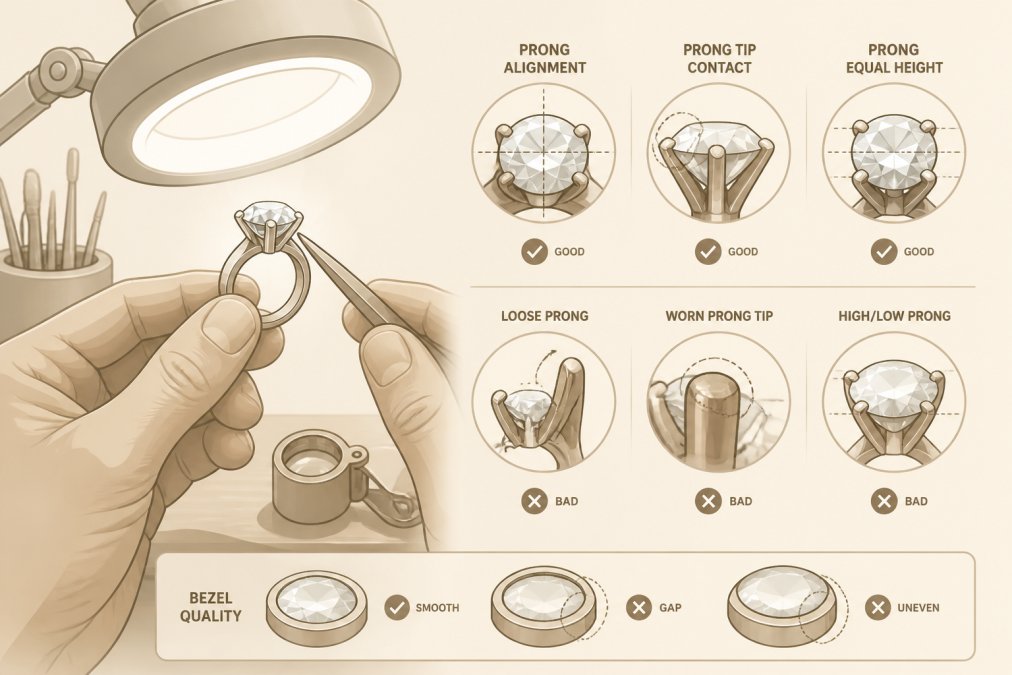
Prong settings use metal fingers to grip and secure a stone. In quality handcrafted work, prongs are evenly spaced, symmetrical, and polished smooth. Each prong should grip the stone firmly without gaps. Look for: Are the prongs the same height? Do they align perfectly around the stone? Is the metal smooth where the prongs meet the stone?
Poor prong work shows obvious flaws. Uneven prongs suggest the artisan didn't file and finish each one properly. Gaps between prongs and stone indicate loose construction or worn settings. Rough, scratchy metal around prongs points to incomplete finishing.
Bezel settings surround the stone with a continuous metal rim, offering more security than prongs. In handcrafted pieces, the bezel metal is smooth, polished, and fits snugly against the stone's edge. The joint where bezel meets stone should be clean and tight, with no visible gaps or rough edges.
Stone alignment matters significantly. Symmetrical stones should sit perfectly centered in their settings. Misaligned stones suggest careless assembly.
Solder joints, the metal connections holding settings to the main piece, are another quality indicator. In handcrafted jewelry, these joints are smooth and invisible or minimally visible. Poor soldering leaves visible seams, rough edges, or discolored metal. Professional artisans blend solder seamlessly through careful technique and finishing.
Recognizing Signs of Poor Jewelry Craftsmanship
Understanding signs of poor jewelry craftsmanship helps you avoid low-quality pieces masquerading as handmade work.
Rough or unfinished edges are the most obvious warning sign. Run your finger along the inner edges of a ring, bracelet, or pendant. Handcrafted pieces should feel smooth with no sharp edges or rough spots. If edges feel scratchy, the artisan either skipped finishing work or lacked skill.
Inconsistent metal thickness suggests cheap materials or poor construction. When you hold a handcrafted piece, the metal should feel substantial and uniform. Compare the weight and feel to similar items you know are quality.
Look for visible gaps in construction. Gaps between components, loose-fitting parts, or visible seams indicate poor assembly. Handcrafted jewelry should fit together seamlessly.
Discoloration or patchy metal finish suggests low-quality base metal or incomplete finishing. Handcrafted pieces made from solid metals develop an even patina over time, but shouldn't show random discoloration when new.
Weak clasps and attachment points are functional red flags. Test clasps on necklaces and bracelets; they should close firmly and require intentional effort to open. Jump rings should be soldered closed, not just bent shut.

Visible tool marks that look random or careless suggest amateur work. Intentional texture is part of handcrafted appeal, but marks should look purposeful.
How to Test Gold Purity at Home
Testing gold purity at home requires simple tools and careful observation. While professional assaying remains the gold standard for absolute certainty, home testing methods provide reliable indicators of whether a piece is genuine solid gold or plated costume jewelry.
The magnet test is quick and effective for initial screening. Genuine gold is not magnetic. Hold a strong neodymium magnet near the piece; if it's attracted, the piece contains significant iron or other ferrous metals, indicating it's not solid gold.
The weight and density test offers more precision. Genuine gold is dense and heavy for its size. Compare a suspected gold piece to a known genuine gold piece of similar dimensions; the real gold will feel noticeably heavier. You can calculate density by weighing the piece on a precision scale, then measuring water displacement by submerging it in a graduated cylinder. Divide weight by volume; gold has a density of approximately 19.3 grams per cubic centimeter.
The acid test is more advanced and requires care. Place a small drop of nitric acid on an inconspicuous area of the piece. Genuine gold doesn't react to nitric acid. If the metal discolors or the acid turns color, the piece contains base metals. This test requires safety precautions: wear gloves, work in ventilation, and never touch the acid.
The ceramic scratch test provides a non-chemical option. Scratch the piece lightly on unglazed ceramic (the back of a ceramic plate works). Genuine gold leaves a golden streak; base metals leave gray or black marks. This test is safe and non-damaging when done carefully on an inconspicuous area.
Professional assaying remains the most reliable method for definitive purity testing. For significant purchases or inheritances, a professional jeweler's assessment provides certainty that home testing cannot guarantee.
Assessing Polish, Weight, and Structural Integrity
The overall finish and construction quality of handcrafted jewelry reveals whether an artisan invested time in completing the work properly.

Polish quality distinguishes handcrafted work from rushed assembly. Run your fingers across the entire surface; it should feel smooth and refined. A high-quality polish reflects light evenly and shows no scratches, pits, or dull spots. Poor polish includes visible scratches, uneven shine, or dull areas. Intentional texture appears purposeful and consistent; accidental poor polish looks random and incomplete.
Weight assessment helps identify material authenticity. Solid gold and sterling silver are significantly heavier than plated alternatives. If a piece purporting to be solid gold feels light and insubstantial, the material composition is likely different from what's claimed.
Structural integrity depends on how well all components are joined and finished. Examine every connection point: where the stone setting attaches to the band, where the clasp connects, where components join. These joints should be invisible or seamlessly blended.
Test the structural integrity of moving parts. Open and close clasps multiple times; they should operate smoothly without wobbling or loosening. Hinges on lockets should move freely without grinding sounds.
The overall weight distribution should feel balanced. An off-balance piece suggests poor design or uneven material distribution, which stresses joints and connections.
Evaluating Craftsmanship Details and Hand-Finished Elements
Hand-finished elements are where genuine artisanal work becomes apparent. These details require skill, patience, and intentional design choices that distinguish handcrafted pieces from mass-produced alternatives.
Intentional surface variations and textures signal authentic handwork. Rather than the perfect uniformity of machine production, handcrafted pieces show subtle variations reflecting the maker's process. Slight variations in metal texture, intentional hammer marks, or hand-applied patterns are proof that a human artisan created each piece individually.
Look for evidence of hand-finishing in hidden areas like the inner band of rings or the back of pendants. Quality artisans finish these surfaces completely. If hidden surfaces are rough or unfinished, the maker cut corners.
Symmetry assessment reveals skill level. Compare both sides of a symmetrical design and both earrings in a pair; they should match precisely. Perfect symmetry in handwork requires skill and attention.
Custom details or personalization demonstrate investment in the piece. Hand-engraved initials, custom stone placement, or unique design elements show the artisan considered this specific piece rather than producing a standard design.
Finishing technique variety in complex pieces shows intentional design. Different finishing techniques in different areas, polished sections next to textured areas, demonstrate the maker understood design and intentionally chose different finishes for visual impact.
The quality of any hand-engraving or hand-stamped details reveals the maker's skill. Engraving should be clean, consistent, and properly aligned. Hand-stamped patterns should be evenly spaced and properly struck.
Maintenance and Longevity Expectations for Quality Pieces
Understanding how handcrafted jewelry ages helps you assess whether a piece will maintain quality over years of wear. Quality handcrafted work is designed for longevity, though maintenance requirements vary by material and construction.
Solid gold and sterling silver pieces develop a natural patina over time, a subtle darkening or color shift many people find appealing. This patina doesn't indicate damage; it's natural oxidation. Regular gentle cleaning removes patina if desired, or you can embrace the aged appearance. Quality handcrafted gold and silver pieces actually improve with age when properly maintained.
Stone settings in quality pieces remain secure for decades. However, prongs can gradually loosen with years of daily wear, and solder joints can eventually weaken. Quality pieces are designed to be professionally serviced; a jeweler can re-tighten prongs or re-solder connections relatively inexpensively.
The inner surfaces of rings and bracelets naturally thin slightly with years of wear and cleaning. This is normal and expected. Quality pieces are made thick enough that reasonable thinning doesn't compromise structural integrity.
Clasps and moving parts require occasional maintenance. Quality clasps remain functional for many years but may need adjustment or replacement eventually. Quality pieces are designed so clasps can be replaced without damaging the rest of the work.
Handcrafted jewelry from reputable artisans often comes with some form of guarantee or repair service, reflecting confidence in the work. At Palms 30A, our handcrafted jewelry collection is selected for durability and lasting quality. Storage and handling practices significantly impact longevity. Store pieces in dry conditions, avoid harsh chemicals, and handle them gently. After five to ten years of wear, quality pieces remain wearable and beautiful; cheap pieces show significant deterioration, discoloration, and structural failure.
Learning how to verify handcrafted jewelry quality transforms you from a passive buyer into an informed consumer. The hallmarks, construction details, and finishing touches you've learned to assess tell the real story of a piece's authenticity and durability. Quality handcrafted jewelry represents genuine artistry and materials designed to last decades, making each piece a meaningful investment. Explore our handcrafted jewelry collection at Palms 30A, where every piece is selected for authentic craftsmanship, superior materials, and the kind of lasting beauty that improves with age. Our curated selection ensures you're investing in work that will enhance your life for years to come.
Frequently Asked Questions
What hallmarks should I look for to verify handcrafted jewelry quality?
Look for metal stamps indicating purity: 925 for sterling silver, 14K or 18K for gold, and maker's marks or artisan initials. Authentic hallmarks are crisp, deeply stamped, and consistent. Mass-produced jewelry often has shallow or poorly aligned stamps. The presence of hallmarks on jewelry suggests the piece meets established standards for precious metals and authenticity. Examine stamps with a jewelry loupe to confirm clarity and depth.
How can I tell if jewelry is handcrafted versus mass-produced?
Handcrafted pieces show subtle imperfections, unique solder joints, and hand-finished details that vary slightly between items. Mass-produced jewelry has uniform, identical characteristics and perfectly smooth surfaces. Look at the inner band of rings for file marks or hand-finishing signs. Check stone alignment and prong setting for slight variations typical of individual craftsmanship. Handmade items often feature unique design elements or custom touches absent in factory-made pieces.
What signs of poor jewelry craftsmanship should I avoid?
Signs of poor jewelry craftsmanship include rough or uneven solder joints, misaligned stones, loose prongs, inconsistent polish, discolored base metal showing through plating, and weak clasp mechanisms. Poor craftsmanship also shows in unfinished edges, visible tool marks that look careless, and stones that sit unevenly in settings. Examine the piece closely for durable construction; quality handcrafted jewelry should feel solid and well-balanced with no rattling or movement of components.
Can I test gold purity at home without professional equipment?
Yes, several home methods exist. The magnetic test works because gold isn't magnetic; if a piece is strongly attracted to a magnet, it contains significant base metal. The weight test compares your piece to a known pure gold sample of similar size. The nitric acid test requires caution but reveals color changes indicating purity levels. However, these methods have limitations and won't provide exact karat values. For definitive purity verification, professional jewelry appraisal remains the most reliable option.
This article was written using GrandRanker