
Tips for Buying Artisanal Clothing Online
Table of Contents
- What to Look for When Buying Artisanal Clothing Online
- How to Identify Quality Handmade Clothing
- Tips for Measuring Yourself for Custom Clothing
- Sustainable Fashion vs Fast Fashion Guide
- Calculating Cost-Per-Wear for Investment Pieces
- Vetting Platform Legitimacy and Avoiding Dropshipping Scams
- Care and Longevity Protocols for Handcrafted Items
- Conclusion
Last Updated: August 21, 2026
What to Look for When Buying Artisanal Clothing Online
When shopping for artisanal clothing online, you're prioritizing quality over convenience. Unlike mass-produced fast fashion, handcrafted pieces demand a different evaluation strategy. At Palms 30A, we've curated artisanal collections for years and learned that buying artisanal clothing online requires attention to details most shoppers overlook. Seam architecture, fiber selection, maker transparency, and production ethics are the actual markers of quality that separate genuine handmade pieces from dropshipping knockoffs.
Seam Architecture and Garment Construction
Hand-stitched seams have an irregular, organic quality that machines cannot replicate. Look for seams that vary slightly in width and spacing, a hallmark of handmade work. Perfectly uniform stitching indicates industrial production.
Quality artisanal pieces feature French seams, bound seams, or hand-finished edges that prevent fraying and extend garment life (peer-reviewed research). Check product photos closely for seam details and ask makers for close-up images. Hand-stitched hems have distinctive variations in stitch length and spacing, while machine hems are perfectly consistent, a red flag for handmade pieces.
Button attachment also reveals craftsmanship. Are buttons sewn with multiple thread passes for durability? Do they have thread wraps underneath for reinforcement? These details indicate a maker who understands garment longevity.
Natural Fiber Weaves and Material Sourcing
Artisanal clothing typically prioritizes natural fibers, linen, cotton, wool, silk, for superior breathability, durability, and aging characteristics (peer-reviewed research). When evaluating artisanal clothing online, ask about fiber content and sourcing. Where did the maker source their materials? Are they using deadstock fabrics, organic fibers, or sustainably harvested materials?
Hand-loomed fabrics have distinctive character that factory weaving cannot match. Slight variations in tension create subtle texture variations that give garments personality. If a maker describes their fabric as hand-loomed, ask for evidence: photos of the loom, details about the weaving process, or supplier references.
Inspect how fabric photographs in different lighting. Natural fibers respond to light differently than synthetics. Cotton has a warm, slightly matte finish. Linen develops a subtle sheen with wear. If the fabric looks plasticky or unnaturally uniform, it's likely synthetic-heavy or machine-produced.
How to Identify Quality Handmade Clothing
The challenge with buying handmade pieces online is that you can't touch the garment before purchase. Visual inspection and maker communication become critical.
Spotting Authentic Handmade Indicators
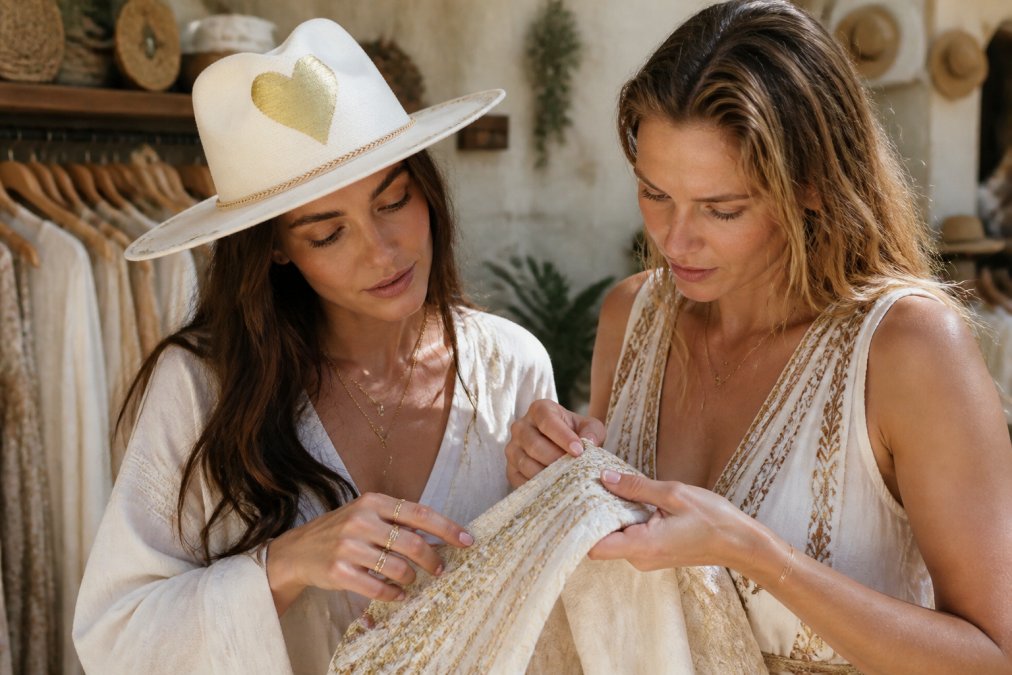
Authentic handmade garments display specific visual markers. Pattern continuity, or intentional lack of it, is most obvious. Handmade pieces often feature slight variations in pattern placement, color distribution, or design elements. This inconsistency proves human creation; machines produce identical repetition.
Look for artisan signatures: hand-embroidered initials, unique labels, or personalized finishing touches. These demonstrate confidence and accountability. Examine color consistency across photos. Hand-dyed or hand-finished pieces show natural color variation due to the dye bath or finishing process. Identical color across all photos suggests machine production.
Check whether the maker provides multiple high-resolution photos from different angles, including close-ups of details and seams. Artisans proud of their work show it comprehensively. Limited, blurry, or single-angle photos are warning signs.
Verifying Maker Transparency and Supply Chain
Investigate the maker directly. Visit their website or social media. Do they show their workspace? Do they post behind-the-scenes production content? Legitimate artisans document their work because they're proud of it.
Ask specific questions: How long does each piece take? What is their production capacity? Real artisans have realistic timelines, they're not producing fifty pieces weekly. Request information about supply chain sourcing and ask for supplier references. Makers committed to ethical production articulate their sourcing decisions in detail.
Look for certifications or partnerships with fair-trade organizations, sustainability initiatives, or craft guilds. These provide third-party verification. Check return and communication policies. Legitimate artisans stand behind their work, offer reasonable returns, and respond quickly to questions. Evasiveness about returns or slow responses suggest dropshipping schemes.
Tips for Measuring Yourself for Custom Clothing
Custom and made-to-order pieces are increasingly common in the artisanal market. Precise measurement is critical, a beautiful handmade garment that doesn't fit is worthless.
Taking Accurate Body Measurements
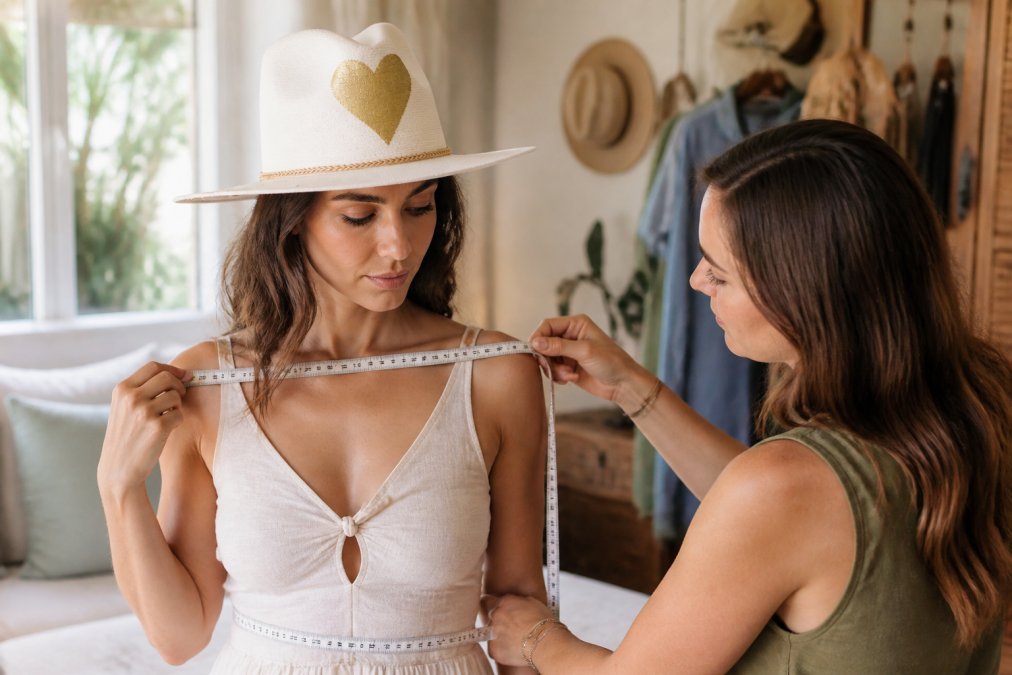
Invest in a soft measuring tape, not a rigid ruler. Wear the undergarment you'll wear with the finished piece. Stand straight but relaxed, and have someone help if possible.
Take measurements at the fullest part of each area: chest at the fullest point of your bust, waist at the narrowest part when you bend slightly, hips at the fullest point. Write down three measurements for each area taken a few minutes apart. Measure consistently in inches or centimeters, don't mix units. Most international makers prefer centimeters.
Include reference measurements if possible. If you own a garment that fits perfectly, measure it flat on a table: pit-to-pit measurement (shoulder width), length from shoulder to hem, and sleeve length. This gives makers a physical reference beyond body measurements. verify fabric quality.
Communicating with Independent Designers
Be specific about what you want. Don't just say "relaxed fit", explain what that means to you. Do you want it loose through the torso but fitted at the hips? Extra room in the sleeves?
Ask about their process. Do they make a muslin prototype first? Can you request adjustments after seeing a sample? Discuss fabric options and request samples if available. This eliminates surprises about color, texture, and weight.
Establish clear timelines and payment terms in writing. How long is production? When do they need payment? What happens if you need mid-production changes? Ask about revisions, most artisans include one round; additional changes may incur fees.
Sustainable Fashion vs Fast Fashion Guide
The artisanal market exists partly as a reaction against fast fashion's environmental and social costs. Fast fashion operates on speed and volume, producing new collections every few weeks and encouraging constant consumption. This creates massive waste in overproduction and discarded garments. Fast fashion relies on cheap labor, synthetics, and polluting manufacturing.
Artisanal and slow fashion operate differently. Makers produce limited quantities, often to order. They invest in quality materials and construction because durability is their selling point. They compete on longevity, uniqueness, and integrity rather than price.
Understanding Ethical Production and Conscious Consumerism
Ethical production means transparency about labor practices. Can you trace who made your garment? Do workers receive fair wages? Are conditions safe? Artisanal makers typically have direct relationships with workers, often in small studios or workshops, creating built-in accountability.
Conscious consumerism means buying less but better. Instead of ten cheap garments annually, buy two or three quality pieces lasting years. This reduces waste, supports skilled makers, and often costs less per wear over time.
Ask makers about environmental practices. Do they use organic, sustainably sourced materials and eco-friendly dyes? Do they minimize production waste? Do they offer repair services? These questions reveal how seriously a maker takes sustainability.
Calculating Cost-Per-Wear for Investment Pieces
Artisanal clothing costs more upfront than fast fashion. A handmade linen shirt might cost $120-$180 versus $25 for factory-made. Cost-per-wear analysis reveals true economics.
Cost-per-wear divides purchase price by wearing frequency. A $150 artisanal piece worn 200 times costs $0.75 per wear. A $25 fast fashion piece worn 10 times costs $2.50 per wear. Quality artisanal pieces typically last 5-10 years; fast fashion lasts 6-12 months (peer-reviewed research).
Calculate your own estimates. How many times will you realistically wear this piece? Over how many years? A $200 piece worn weekly for five years (260 wears) becomes $0.77 per wear. Match your spending to actual usage patterns, everyday basics are good candidates for artisanal quality; trendy pieces are better as fast fashion.
Vetting Platform Legitimacy and Avoiding Dropshipping Scams
The artisanal market has attracted scammers posing as makers but dropshipping factory-produced goods. Learning to identify them protects your wallet and supports real artisans.
Dropshipping operations display warning signs: massive variety across unrelated categories (clothing, jewelry, home goods, accessories), all allegedly handmade. Real artisans specialize. Check production timelines, dropshipping offers immediate shipping or very short lead times. Real artisans need time to create custom pieces.
Investigate the maker's online presence. Legitimate artisans have consistent branding across platforms. Dropshipping operations often have generic branding and stolen photos. Reverse-image search product photos; if the same photo appears on multiple unrelated sites, that's a major red flag.
Real artisans provide bios, workspace photos, and background details. They're proud of their story. Dropshipping sites provide vague descriptions like "handcrafted by artisans" without naming anyone. Read customer reviews carefully, do reviewers mention the maker by name and describe specific customization? Or do reviews sound generic, focusing only on shipping speed? Examine return policies. Dropshipping operations often have restrictive returns; real makers are usually more flexible.
Care and Longevity Protocols for Handcrafted Items
The investment in artisanal clothing only pays off with proper care. Ask makers for specific care instructions. Hand-dyed pieces may bleed color initially. Hand-loomed fabrics may need gentle handling. Some pieces benefit from hand-washing; others are machine-washable but need cold water and gentle cycles.
Wash less frequently than expected. Artisanal pieces last longer when washed sparingly, many only need washing every 3-5 wears. Spot-clean between washes. Use gentle detergents designed for delicate or natural fibers. Dry flat or hang-dry whenever possible; machine drying accelerates wear and can shrink natural fibers.
Store pieces properly during off-season using acid-free tissue paper, cedar blocks, or lavender sachets. Keep away from direct sunlight, which fades colors. Consider repair services, many artisans offer repairs for their own work. A small tear fixed immediately never becomes a large problem. Some makers offer resizing or alteration services, extending piece longevity long-term.
Shopping for artisanal clothing online requires more effort than fast fashion, but that effort pays dividends. When you understand what to look for, seam quality, material sourcing, maker transparency, and ethical practices, you can confidently invest in pieces reflecting your values and lasting for years. At Palms 30A, we've curated handcrafted items including pieces like our Pluma Embroidered Hat, hand-stitched by skilled female Mexican artisans, and our Square Rattan Clay Earrings, handcrafted polymer pieces designed for durability and everyday wear. Start with pieces aligning with your lifestyle, measure carefully for custom items, and build relationships with makers who stand behind their work.


Frequently Asked Questions
How can I tell if clothing is truly handmade when buying artisanal clothing online?
Authentic handmade garments show visible signs of craftsmanship: irregular seams, hand-stitched details, and natural fiber weaves with slight pattern variations. Ask the maker for photos of their production process, information about their artisan team, and supply chain transparency. Handmade items rarely look perfectly uniform because they're made by human hands, not machines. Check for brand transparency by requesting maker credentials and production ethics documentation.
What makes sustainable fashion different from fast fashion?
Sustainable fashion prioritizes ethical production, natural fiber sourcing, and garment longevity, typically involving small-batch or made-to-order production by independent designers. Fast fashion relies on mass production, synthetic materials, and rapid inventory turnover. Artisanal clothing supports conscious consumerism by reducing waste and ensuring fair labor practices. Small-batch production means fewer items produced, lower environmental impact, and higher quality standards than conventional manufacturing.
How do I know if an online platform selling artisanal goods is legitimate?
Vet platform legitimacy by checking for clear maker information, production ethics statements, and verifiable return policies. Legitimate artisanal retailers provide maker bios, production locations, and material sourcing details. Avoid dropshipping scams by looking for sites that claim handmade or artisanal items but show identical photos across multiple vendors. Request digital measurement verification or ask the seller about their quality control process before purchasing.
Is the higher price of artisanal clothing worth the cost?
Calculate cost-per-wear to justify artisanal pricing. A $148 handwoven hat worn 50 times costs $2.96 per wear, while a $30 mass-produced hat worn 5 times costs $6 per wear. Artisanal items offer durable goods quality, heritage craftsmanship, and ethical production that justify investment. Supporting independent artisans ensures fair compensation and sustainable practices, making each purchase meaningful beyond just the garment itself.
This article was written using GrandRanker