

Artisan Jewelry vs Mass Produced Jewelry: Which to Buy
Last Updated: November 2, 2026
Quick Summary
Artisan jewelry is designed and made by an individual maker or small workshop who controls the shaping, assembly, and finishing of each piece, while mass-produced jewelry is replicated at volume from a fixed design. The core difference comes down to who makes a piece and how much human judgment goes into it, which drives variation, price, repairability, and lifespan.
- Handmade is a process, not a quality grade, and treating it as one is the most common shopper mistake.
- Bench work passes each piece through human hands, so small variations appear between pieces.
- Handmade jewelry is not automatically more durable; durability depends on maker skill and material quality.
- Compare lifespan and repair access rather than sticker price, since the cheapest piece often costs the most per wear.
- Spot handcrafted jewelry by comparing two of the same design and checking for small differences.
Table of Contents
- Artisan Jewelry vs Mass Produced Jewelry: The Core Difference
- Artisan Jewelry Meaning: Definitions That Actually Hold Up
- Types of Jewelry Manufacturing: From Bench Work to Assembly Line
- Craftsmanship, Durability, and Quality Control
- Price, Labor Costs, and Total Cost of Ownership
- How to Spot Handcrafted Jewelry Before You Buy
- How to Care for Handcrafted Jewelry So It Lasts
- Choosing Your Piece From the Palms 30A Collection
- Frequently Asked Questions
Artisan Jewelry vs Mass Produced Jewelry: The Core Difference
The core difference between artisan jewelry vs mass produced jewelry comes down to who makes a piece and how much human judgment goes into it.
One detail matters more than any label on a tag. A piece made by hand is only as good as the hands that made it.
Below, we break down the real differences, where the extra cost goes, and how to check a piece before you commit.
Artisan Jewelry Meaning: Definitions That Actually Hold Up
Artisan jewelry is jewelry designed and made by an individual maker or small workshop, where a person controls the shaping, assembly, and finishing of each piece rather than a machine replicating one fixed design.
The labels get used loosely, which is why shoppers end up confused. Here is how they actually differ.
Handmade, Handcrafted, Artisan, Machine-Made
- Handmade: The piece was physically assembled by hand. This says nothing about design originality or material quality.
- Handcrafted: Similar to handmade, but usually implies skill and care in the making. Still not a regulated term.
- Artisan: Made by a named maker or small workshop with design control. The strongest of the four labels, and the one most often stretched.
As Crafted by Citrus explains in its comparison of handmade and mass-produced jewelry, the real dividing line is the degree of human involvement in the production process, not the wording on the label.
The labels get used loosely, so here is how the four common terms actually differ.
| Label | What it means | Key difference |
|---|---|---|
| Handmade | Physically assembled by hand | Says nothing about design originality or material quality |
| Handcrafted | Similar to handmade, implies skill and care | Still not a regulated term |
| Artisan | Made by a named maker or small workshop with design control | Strongest of the four labels, most often stretched |
| Machine-made | Produced by automated equipment or an assembly line | Consistent, repeatable, and usually cheaper |
Types of Jewelry Manufacturing: From Bench Work to Assembly Line
Jewelry manufacturing falls into two broad methods: bench work, where a jeweler shapes and finishes a piece by hand, and assembly-line production, where machines and stations replicate a fixed design at volume. The difference is not just who holds the tools. It is how many decisions get made per piece, and where in the process those decisions happen.
How Bench Work Actually Unfolds
Bench work moves a single piece through a sequence of steps, usually with one maker or a small team handling several of them:
- Design and model. The maker sketches or carves a model, sometimes in wax, sometimes directly in metal.
- Casting or fabrication. Metal is cast from the model or cut, bent, and soldered from sheet and wire.
- Cleanup. The piece is filed, sanded, and smoothed. This is where tool marks and hand-finished edges come from.
- Stone setting. Stones are set one at a time, often with hand tools, and each seat is checked individually.
- Finishing. Polishing, texturing, or patina is applied by hand, and the maker inspects the piece before it ships.
Because each step passes through human hands, small variations appear between pieces. A bezel might sit a fraction differently, or a hammered texture might land unevenly. Those variations are the fingerprint of bench work.
How Assembly-Line Production Unfolds
The same steps exist, but they are split across machines and stations, and each station repeats one action thousands of times:
- CAD design. A design is drafted as a digital file and can be adjusted before any metal is cut.
- Casting at volume. Wax patterns are produced by machine, often in a tree, and cast in batches.
- Automated cleanup. Tumbling, vibratory finishing, and polishing machines smooth many pieces at once.
- Station-based assembly. Stone setting may be done by a dedicated setter or by machine, and clasps and findings are attached at a separate station.
- Batch inspection. Quality control samples a run rather than inspecting every piece individually.
The output is consistent, and consistency is the point. Two identical pieces from the same run should look the same, which is exactly what a large retailer or event order needs.
Where Hybrid and Small-Batch Production Fit
Most jewelry sold today sits between the two extremes. A maker might cast from a CAD model, then hand-finish every piece. That is hybrid production, and it is common.
Neither approach is dishonest. The problem is when a hybrid piece gets marketed as fully handmade.
Ask a simple question: how many of these were made, and who finished them? A maker with nothing to hide will answer directly.
Watch out: a maker who says "handmade" but cannot describe the casting or finishing steps is usually describing a hybrid process, not bench work.
Craftsmanship, Durability, and Quality Control
Handmade jewelry is not automatically more durable than mass-produced jewelry. That surprises people, but it holds up.
A poorly soldered handmade setting can fail faster than a well-engineered machine-made one. Mass production also brings standardized quality control, which catches defects at volume.
What artisan work can offer is individual attention. A skilled jeweler can spot a weak joint and fix it before the piece ships, but that depends entirely on the maker.
Price, Labor Costs, and Total Cost of Ownership
Artisan jewelry costs more because you are paying for time. Hand-finishing, stone setting, and design work are hours a machine does not need. Labor is the largest line item in the price of a handmade piece, but it is not the only one, and understanding the rest helps you judge whether a price is fair.
What Actually Drives the Price
- Labor hours. Bench work, stone setting, and finishing are the biggest cost. A piece with hand-set stones and a hand-finished surface takes far longer than a cast-and-tumble piece.
- Material quality. Solid gold, sterling silver, and natural gemstones cost more than plated base metal and synthetic stones. Material choice often matters more to durability than the production method.
- Design and tooling. A one-off design carries its full development cost on a single piece. A mass-produced design spreads tooling and CAD work across thousands of units.
Mass-produced jewelry spreads those costs across thousands of units, which is why it lands lower on the shelf. That lower price is real, but it is not the whole story.
The Total Cost of Ownership Math
The bigger question is total cost of ownership. A piece you can repair and re-wear for years often costs less per wear than a cheap piece you replace twice. The variables that matter:
- Repairability. A hand-set stone can usually be tightened or replaced by a jeweler. A glued or molded setting often cannot be repaired without replacing the whole component.
- Resizing. Solid metal bands and settings can often be resized. Plated or hollow pieces usually cannot.
- Expected lifespan. A well-made piece in solid metal can be worn for years with basic care. A plated piece may wear through its plating with regular wear (Buying Platinum, Gold, and Silver Jewelry).
A common pattern is that the cheapest piece costs the most per wear, because it gets replaced.
If you are weighing that math, our guide on whether handmade jewelry is worth the investment walks through the value case in more detail.
Watch out: a low price with no repair policy and no named maker is usually a replacement purchase, not an investment.
How to Spot Handcrafted Jewelry Before You Buy
You can spot handcrafted jewelry by looking for small variations between pieces, visible tool marks, hand-finished edges, and a maker willing to explain the process.
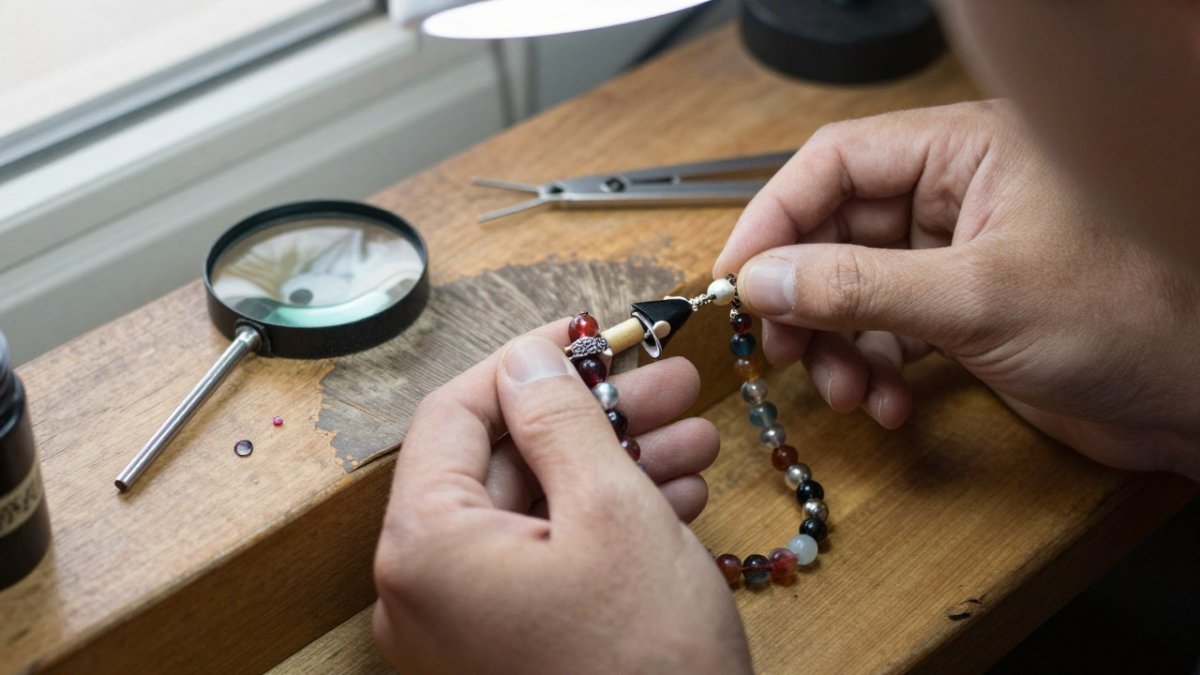
Use this checklist before you buy:
- Compare two of the same design. Small differences suggest hand work.
- Turn the piece over. Hand-finished backs and edges look less uniform than molded ones.
- Ask who made it and where. A named workshop is a good sign.
Watch out: "artisan style" and "handcrafted look" are marketing phrases, not production claims. If a listing never names a maker or a workshop, treat the label as decoration.
For a deeper walkthrough of these checks, see our guide on how to verify handcrafted jewelry quality.
How to Care for Handcrafted Jewelry So It Lasts
Handcrafted jewelry lasts longest when you keep it dry, store it separately, and clean it gently. Hand-finished surfaces and natural stones are less forgiving than heavily plated mass-market pieces.
- Put jewelry on last, after lotions and perfume have dried.
- Remove pieces before swimming, showering, or cleaning.
- Store each piece in its own pouch so beads and metal do not scratch.
The natural variation in gemstones is part of the appeal, not a flaw. Treat each piece as slightly individual and it will hold up better.
Choosing Your Piece From the Palms 30A Collection
Our handcrafted jewelry collection features pieces with visible human work in them. Start with the Heishi Beaded Necklaces, made with meticulously crafted heishi gemstones where natural variation gives each strand its own character. The Hand Painted Ceramic Charms Beaded Necklace pairs hand-painted ceramic charms with beaded gemstones.

For a gift, the hand-painted ceramic charms are individually painted and work as a small, personal add-on. If you want handcast metal, the Butterfly Bangle and Bee Bangle are handcast in gold.


Best for: shoppers who want natural material variation and handcrafted detail.
Skip if: you need dozens of identical pieces for an event, where machine-made consistency wins.
Frequently Asked Questions
How can you tell if jewelry is handmade or mass-produced?
Look at the back of the piece, the clasp, and the joins. Handcrafted jewelry usually shows small tool marks, slight variation between pieces, and hand-set stones, while machine-made pieces are uniform to the millimeter. Ask the seller who made it and where. A maker who can name the workshop, the materials, and the finishing process is describing real production. Vague language like 'artisan-inspired' with no maker attached is a signal to keep looking.
Is artisan jewelry more durable than mass-produced jewelry?
Not automatically. Durability depends on the skill of the maker and the quality of the materials, not on whether hands or machines shaped the piece. A well-cast mass-produced ring in solid gold can outlast a poorly finished handmade one. What artisan jewelry often offers is better repairability, because a bench jeweler can re-solder a joint or replace a single stone. Judge the piece itself: metal type, stone setting, clasp quality, and finish.
What are the main types of jewelry manufacturing?
Four processes cover most jewelry sold today: hand fabrication at a bench, casting from a mold or wax model, CAD design paired with machine production, and assembly-line manufacturing where components are made in bulk and joined in volume. Many small studios combine casting with hand-finishing, which is why the handmade versus machine-made label rarely fits neatly. Ask which steps were done by hand and which were not.
Why does artisan jewelry cost more than mass-produced pieces?
Labor is the biggest factor. A single maker finishing one necklace takes far longer than an assembly line producing thousands. Small studios also buy materials in smaller quantities, so they pay more per ounce of metal or per strand of gemstones. That higher price buys individual variation, a named maker, and a piece that can usually be repaired rather than replaced. Compare the material quality and the finishing, not just the number on the tag.
How should I care for handcrafted jewelry?
Keep handcrafted pieces away from water, perfume, and lotion, and put them on last when getting ready. Wipe beaded and ceramic pieces with a soft dry cloth rather than soaking them, since moisture can loosen knots and dull a hand-painted finish. Store each piece separately in a pouch so metal parts do not scratch. Check clasps and stringing every few months, and have a bench jeweler re-string or tighten anything that feels loose before it breaks.
The real challenge in artisan jewelry vs mass produced jewelry is not picking a side. It is knowing which pieces are actually handmade and which are just labeled that way. Palms 30A curates a handcrafted jewelry collection with named makers, natural gemstone variation, and pieces we can speak to directly, alongside original art pieces and gifts for the whole family. Get started with Palms 30A and find a piece you will still be wearing years from now.
