
Curated vs Boutique Shopping Sites: What's the Difference?
Table of Contents
- Curated vs Boutique: What's the Real Difference?
- How Curation and Product Discovery Differ Online
- Comparing Selection, Pricing, and Quality Assurance
- The Benefits of Shopping Small Boutique Brands
- How to Find Unique Artisanal Goods Online
- Best Practices for Ethical Boutique Shopping
- Which Shopping Experience Should You Choose?
- Frequently Asked Questions
Last Updated: September 5, 2026
Online shopping has split into two philosophies: do you want an algorithm to find you products, or a human with taste to choose them? At Palms 30A, we've built our model around the latter. This guide breaks down what separates true curation from mass-market aggregation so you can shop with intention.
Curated vs Boutique: What's the Real Difference?
Curated shopping is the practice of a knowledgeable buyer personally selecting a limited range of items that meet a specific aesthetic, quality, or lifestyle standard. Boutique shopping refers to purchasing from a small, independent retailer that carries that hand-picked inventory, often with a distinct brand ethos and a physical or digital storefront that feels personal rather than transactional.
The distinction matters. An algorithm-driven marketplace can technically "curate" recommendations, but it lacks the editorial judgment, quality assurance, and accountability of a real buyer who has touched and tested each piece. Mass retail platforms aggregate thousands of brands with little oversight; a genuine boutique stakes its reputation on every item it carries.
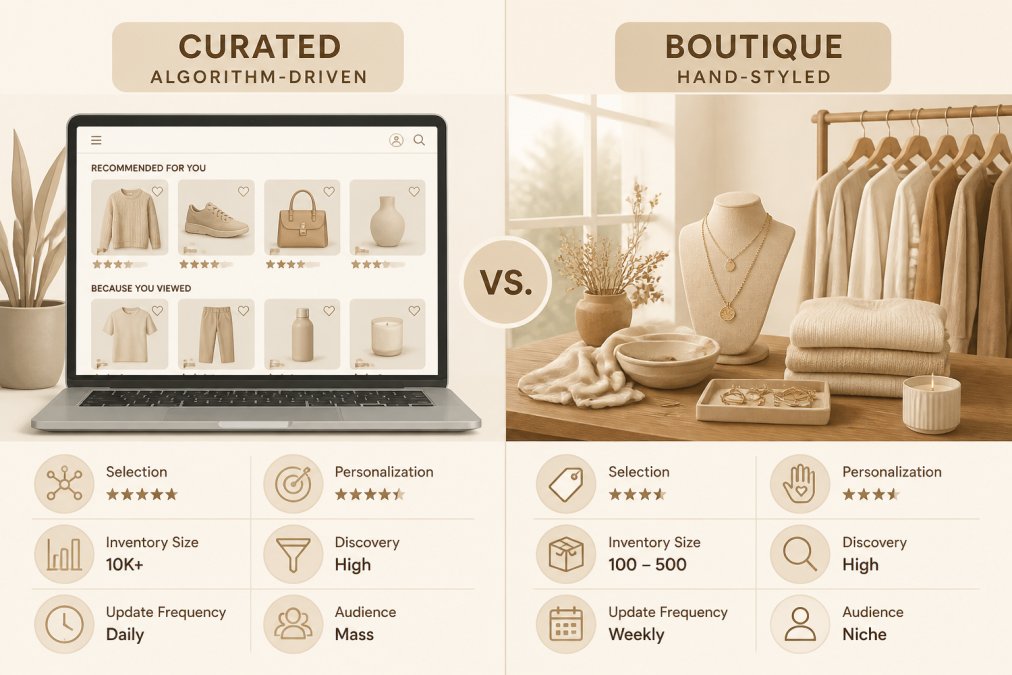
That accountability is the hidden value proposition. When a curated boutique like Palms 30A selects a charm necklace, we're endorsing its craftsmanship, materials, and fit within a cohesive collection. Both models rely on the same principle: a trusted intermediary whose taste you can rely on.

How Curation and Product Discovery Differ Online
The real, day-to-day difference shows up in the mechanics of the site itself, how you search, filter, and navigate. This technical UX gap directly determines whether you find what you need or abandon your cart in frustration.
Search and Filter Logic: The Core Divergence
A mass-market aggregator optimizes for breadth. Its search bar surfaces as many relevant SKUs as possible, with filters for brand, price, rating, and shipping speed. The logic is Boolean: it matches keywords and returns every fitting listing. This works when you know exactly what you want, but collapses when you are shopping for a feeling or a style.
A curated boutique site, by contrast, often de-emphasizes the search bar. Navigation is organized around lifestyle themes or aesthetic categories like "Weekend Layers" or "Gifts Under $50." Filters are typically limited to size, color, and price. This is deliberate: we have already done the filtering for you; your job is to choose, not to hunt.
The Problem of "Filter Fatigue" on Aggregator Sites
Aggregator platforms create what UX researchers call "filter fatigue." You start with a broad query, apply a dozen filters, and still end up with hundreds of pages of listings. Each filter creates a trade-off: a price range might exclude a well-made discounted item, and sorting by "top rated" often surfaces generic, mass-produced goods.
On a curated site, the absence of granular filters is a signal. When a boutique presents 15 dresses instead of 1,500, it is making a claim about each one. The lack of a "sort by review count" button forces you to engage with the description, materials, and styling notes, exactly what the curator intended.
Browsing Behavior: Directed vs. Exploratory
Aggregator sites are built for directed shopping: you know the product, you find it, you leave. Curated sites are built for exploratory shopping: you browse, discover a piece you did not know existed, and often purchase outside your initial intent. A boutique's economic model depends on increasing order value through discovery; the aggregator model depends on volume and price competition.
A practical test: open a curated boutique and an aggregator side by side. On the aggregator, search for a gift for a friend who likes minimalist jewelry, you will see thousands of results from unknown sellers. On the curated site, you will see a tight edit of 20 to 30 pieces, each with a description of the material, maker, and why it fits the collection. The former requires you to be the curator; the latter trusts a professional.
Why This Matters for Your Purchase Decision
The technical UX difference is about risk. On an aggregator, the burden of quality assessment falls on you, reading reviews, checking seller ratings, comparing photos. On a curated site, the store has already performed that due diligence. When you buy from a boutique that states its sourcing standards, you rely on a human's judgment, not a recommendation engine's correlation. You can verify this in under five minutes by testing the search and filter functions on any site.
Comparing Selection, Pricing, and Quality Assurance
| Factor | Curated Boutique | Mass-Market Aggregator |
|---|---|---|
| Selection | Small, intentional, cohesive | Vast, varied, often overwhelming |
| Pricing | Reflects quality and sourcing | Competitive, frequently discounted |
| Quality Assurance | Hand-checked by a human buyer | Varies by individual seller |
| Accountability | Store's reputation on every item | Limited responsibility for third-party goods |
| Post-Purchase Support | Direct, personal, responsive | Often automated or outsourced |
Pricing is where the comparison gets most contentious. A hand-picked piece from a small retailer costs more than a mass-produced equivalent, and that gap is what you're paying for. It covers ethical sourcing, higher-quality materials, and honest pricing that reflects what the item costs to make well.
Quality assurance is the quiet advantage of boutique shopping. When a store like Palms 30A carries a Charm Necklace Heart, Cross, Sunburst, Stone for $38.00, the price reflects lead and nickel compliance, and a design that has been physically handled and approved. Mass-market platforms cannot offer that level of verification across thousands of third-party listings.
The Benefits of Shopping Small Boutique Brands
Shopping small boutique brands supports an independent retail ecosystem that mass-market platforms cannot replicate. Your money goes directly to a business owner with a personal stake in your satisfaction, not a faceless corporation optimizing for quarterly returns.
The benefits extend beyond the transaction. Boutiques offer personalized styling guidance, answering a sizing question or suggesting a piece that completes an outfit. This expertise comes from the same person who selected the inventory, so the advice is grounded in product knowledge, not a script.
Customer retention is the lifeblood of a successful boutique. Unlike a marketplace where buyers rarely return to the same seller, boutiques cultivate ongoing relationships. A customer who buys a Wrapped in Prayer Bracelet for $26.00 as a gift might return for the Little Luxuries Tiny Moments Kit at $18.00 for a friend's birthday, then come back for something for themselves.

How to Find Unique Artisanal Goods Online
Finding unique artisanal goods online requires knowing where to look. Start by searching for independent retailers in specific regions or lifestyle niches rather than generic product terms, which mostly surface mass-market results.
Look for signs of real curation. A genuine boutique will have detailed product descriptions mentioning materials, sourcing, and the maker where possible. They'll often group items into collections or sets, like the Adela Set at $111.30, demonstrating that a human has thought about how pieces work together rather than dumping inventory into categories.

Check for a clearly articulated brand ethos. Boutiques that take curation seriously will explain their point of view: what they carry, what they refuse to carry, and why. This transparency is a reliable indicator that the selection is intentional. According to guidance on ethical sourcing and supply chain transparency, consumers should expect clear information about product origins and materials, and boutiques that provide it are typically more trustworthy.
Best Practices for Ethical Boutique Shopping
Most articles on ethical shopping stop at "ask questions about materials and sourcing." That advice is useless without a framework for verifying the answers. The gap is supply chain transparency metrics, concrete, checkable signals that separate a genuinely ethical boutique from one that uses sustainability language as a marketing veneer.
The Verification Framework: What to Actually Check
Before you buy from any boutique, run it through a four-point verification checklist. This is not about distrusting small businesses; it is about confirming that their claims are specific enough to be meaningful.
1. Material Origin Specificity. A genuine boutique will name the material and often the region or mill. "100% Pima cotton grown in Peru" is verifiable; "premium cotton" is not. The same applies to jewelry: "14k gold-filled, lead and nickel compliant" is testable, whereas "quality metals" tells you nothing. If a description cannot name the material, the store either does not know or does not want you to know.
2. Production Process Disclosure. Look for mentions of how the item is made, hand-finished, small-batch, or made-to-order. A boutique carrying handcrafted jewelry should tell you whether the piece is cast, stamped, or fabricated, and whether the maker is local or overseas. Vague language like "ethically sourced" without a description of the process is a red flag.
3. Compliance and Safety Standards. For jewelry and children's items, compliance with Consumer Product Safety Commission (CPSC) guidelines for lead and nickel is a legal requirement (cpsc.gov). A boutique that explicitly states compliance, as Palms 30A does with its charm necklaces, has done the regulatory homework. A store that stays silent may be cutting corners on testing.
4. Return Policy and Post-Purchase Accountability. Ethical shopping does not end at checkout. A boutique that stands behind its products will offer a return window that gives you time to assess quality in person. Compare this to aggregators where returns are routed through third-party logistics and disputes are handled by automated systems. The willingness to accept a return is a direct measure of confidence in the product.
The Price Transparency Test
A common pattern among ethical boutiques is honest pricing that reflects actual costs. This does not mean the cheapest option is unethical or the most expensive is better. It means the store should explain the price breakdown: materials, labor, shipping, and margin. When a boutique sells a piece for $26.00, that price should be defensible. A response of "it's worth it" is weaker than "the materials cost X, the artisan labor cost Y, and our margin is Z."
Red Flags That Override Everything
Certain signals should end your consideration of a boutique immediately, regardless of how beautiful the product photos are:
- No physical address or contact information beyond a contact form
- Product descriptions that use only subjective terms like "stunning," "premium," or "luxury" without material specifics
- No care instructions for clothing or jewelry
- A return policy that requires you to pay for return shipping without exception, which shifts the risk entirely onto you
Why This Framework Matters
The curated vs. boutique decision is about accountability. A genuine boutique stakes its reputation on every item it carries, and that stake is verifiable through the specificity of its claims. By applying this four-point framework, you move from trusting a vibe to verifying a standard, the difference between shopping ethically and shopping with the intention of being ethical.
Which Shopping Experience Should You Choose?
Choose a curated boutique when you value a personal point of view, want assurance about quality and sourcing, and prefer a smaller, intentional selection that saves time. Choose a mass-market aggregator when you need a specific item quickly, want to compare many options, or are shopping on a tight budget where price is the primary concern.
The decision ultimately reflects your priorities as a consumer. If you're tired of endless listings, skeptical of quality claims from unknown sellers, and looking for pieces that feel personal rather than mass-produced, a curated boutique is the better fit. The trade-off is a higher price point and smaller selection, but you gain confidence in every purchase.
For families, gift-givers, and anyone seeking those little luxuries, Palms 30A offers the warmth and personal touch of a true boutique with the convenience of online shopping. Our curated collections of clothing for women, men, and children, handcrafted jewelry, and original art pieces are chosen to add genuine style to your home and wardrobe. As research on consumer trust in independent retailers suggests, shoppers increasingly favor businesses where they feel a human connection and a shared set of values.
===
Frequently Asked Questions
What defines a curated shopping site versus a traditional boutique?
A curated shopping site offers a hand-picked selection across many brands, often focused on a specific lifestyle or aesthetic. A traditional boutique typically operates as an independent retailer with a smaller, more localized inventory. Both rely on expert recommendations, but curated platforms may use algorithms alongside human selection. The best curated vs boutique experience depends on whether you prefer broad but intentional choice or a deeply personal, community-curated feel.
Are curated stores more expensive than independent boutiques?
Not necessarily. Price depends on the brands and materials, not the store type. Curated platforms can negotiate bulk pricing, while boutiques often focus on ethical sourcing and honest pricing for smaller runs. You are paying for quality assurance and the expertise of the selection, not just the item. Compare the value proposition of specific pieces, like a $38 charm necklace, against mass-market equivalents to judge true cost.
How does inventory management differ between curated platforms and boutiques?
Curated platforms often use data-driven inventory management to track trends and minimize overstock. Boutiques, especially independent retailers, tend to buy in smaller, niche inventory batches based on the owner's taste and customer requests. This means boutiques can offer more unique artisanal goods, but curated sites may have more consistent stock levels and faster shipping for popular items.
What should I look for when evaluating the reputation of a boutique?
Look for consumer trust signals like clear return policies, detailed product descriptions, and transparent sourcing information. Check if they share details about ethical sourcing or the makers behind their products. Read reviews that mention post-purchase support, not just the product itself. A reputable boutique will be clear about its brand ethos and quality assurance processes, just like a well-run curated platform.
Finding a shopping experience that matches your values takes some effort, but the payoff is purchases you feel good about long after the transaction. Palms 30A makes that choice easy with hand-picked clothing, jewelry, and home accessories that bring warmth and style to everyday life. View our full collection and discover the difference that genuine curation makes.
This article was written using GrandRanker